Energy-Busting Indoor Games for Toddlers on Rainy Days: The 2026 Parent’s Survival Guide


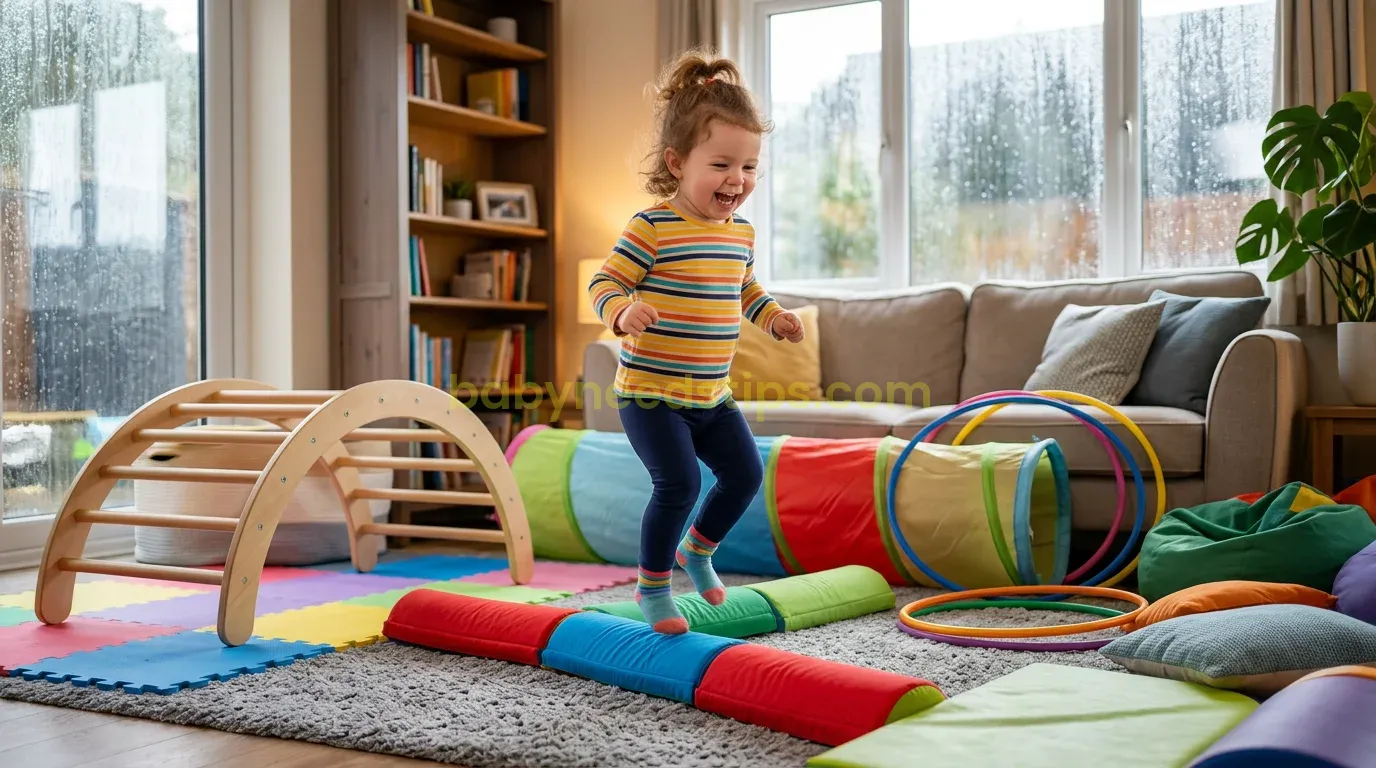
In my experience, there is a specific kind of atmospheric pressure that builds inside a home when it has been raining for three days straight and you have a three-year-old. It isn’t just the humidity; it’s the palpable, vibrating energy of a toddler who hasn’t had the chance to run full-tilt across a grassy park. As of April 2026, we are seeing more parents than ever grappling with the “indoor energy gap.” With urban living spaces becoming more compact and extreme weather patterns becoming the new normal, the ability to transform a living room into a high-octane physical development zone isn’t just a fun “extra”—it’s a vital survival skill for modern parenting.
When you are staring down a grey Saturday morning, the temptation to reach for the tablet is real. However, recent data from the start of 2026 suggests that the average two-year-old is now clocking nearly 140 minutes of screen time daily, significantly exceeding the World Health Organization’s (WHO) recommended limit of 60 minutes. From what I’ve observed, the “zoomies” you see in your toddler are actually a biological SOS. Their growing bodies require massive amounts of input to develop the gross motor skills, bone density, and neural pathways that will define their physical health for a lifetime.
This guide is designed to move beyond the “just put on a movie” mentality. We are going to explore science-backed, energy-busting indoor games that satisfy your toddler’s need for “moderate-to-vigorous physical activity” (MVPA) while keeping your furniture—and your sanity—relatively intact. Whether you are living in a studio apartment or a sprawling suburban home, these activities are about maximizing movement in limited spaces.
The Science of Toddler Energy: Why 180 Minutes is the Magic Number
If you feel like your toddler never stops moving, it’s because they aren’t supposed to. According to the latest CDC and WHO guidelines updated for 2026, toddlers (aged 1–2) and preschoolers (aged 3–4) require a minimum of 180 minutes of physical activity spread throughout the day. In my experience, most parents are surprised by that “3-hour” figure. They often think a 20-minute walk or a quick session on the backyard swing set covers it. But for a toddler, “activity” includes everything from standing and rolling to high-intensity jumping and running.
Why is this so critica[1]l? Physical activity in these early years is the primary driver of gross motor development. Dr. Sarah Jordan, a pediatric researcher, noted in a 2025 symposium that “the movements toddlers make—the jumping, the awkward crawling, the heavy pushing—are essentially programming their brain’s spatial awareness and coordination.” When we restrict this movement due to rain, we aren’t just dealing with a cranky kid; we are momentarily pausing a critical developmental window.
Furthermore, a landmark longitudinal study published in April 2026 by the University of Montreal followed nearly 1,700 children and found that active play habits established at age 2.5 are the single strongest predictors of physical fitness at age 12. As researcher Linda S. Pagani stated, “Family habits breed individual habits… by encouraging active play… parents exert a durable, measurable influence on their children’s long-term well-being.” When you engage in these indoor games, you aren’t just passing time; you are building a teenager who likes to move.
| Age Group | Recommended Daily Activity | Activity Intensity |
|---|---|---|
| Infants ( | 30+ mins Tummy Time | Floor-based play, reaching |
| Toddlers (1-2 years) | 180 mins (3 hours) | Light to vigorous (climbing, walking) |
| Preschoolers (3-4 years) | 180 mins (at least 60 mins MVPA) | Running, jumping, “heavy work” |
| Children (5-17 years) | 60 mins daily | Moderate-to-vigorous intensity |
Balloon Games: The Ultima[2][1][3]te Low-Impact Energy Buster
In my experience, the humble balloon is the single greatest indoor play tool ever invented. It is the only “ball” that you can allow a toddler to hit with maximum force inside a house without risking a shattered vase or a hole in the drywall. From a developmental perspective, balloons are fascinating because they move slowly. This “slow-motion” flight gives toddlers, whose hand-eye coordination is still maturing, the extra milliseconds they need to track the object and react.
One of our favorite games is “Balloon Lava.” The rules are simple: the balloon is a precious ember that cannot touch the “lava” (the floor). According to recent play-therapy data, games like this promote “bilateral coordination”—the ability to use both sides of the body together. You can level this up into “Balloon Tennis” by using paper plates taped to paint stirrers as rackets. This adds a layer of “manipulative movement,” a category of gross motor skill that involves using an object to move another object.
If you find that your toddler [4][5]is getting bored with just hitting it up, try “Balloon Waddle.” Have them place the balloon between their knees and “waddle” from one side of the room to the other. This targets the hip abductors and core stability, muscles that are essential for the “stability movements” described by developmental experts. It’s a high-energy task that burns significant calories without requiring much space. In 2026, we’ve seen a rise in “se[6]nsory-integrated play,” where parents put a few grains of rice inside the balloon before inflating it to add a sound element, making the game even more engaging for neurodivergent toddlers who crave auditory feedback.
DIY Obstacle Courses: Turning Your Living Room into a Gym
When you can’t go to the playground, you must bring the playground to the couch. In my experience, an indoor obstacle course is the “heavy hitter” of rainy-day activities. The goal here is to hit all four types of movement: locomotor (getting from A to B), non-locomotor (stretching/bending), manipulative (moving objects), and stability (balancing).
We recommend using common househol[5]d items to create a “circuit.” For example:
- The Tunnel: A [3][4][7]row of dining chairs with a blanket draped over them. Crawling is a “cross-lateral” movement that strengthens the connection between the left and right hemispheres of the brain.
- The Lily Pads: Sofa cushions or pillows placed 12 inches apart on the carpet. (Avoid hardwood floors for this to prevent slips). This builds “bone-strengthening” impact through jumping.
- The Tightrope: A strip of blue painter’s tape on the floor. Ask your toddler to walk it heel-to-toe. This is a classic stability exercise used in occupational therapy to improve vestibular (balance) processing.
- The Pizza Delivery: Have them carry a small, weighted object (like a beanbag or a plastic plate with a stuffed animal on it) through the course without dropping it.
According to a 2025 report from New Horizon Academy, the key to a successful obstacle course is “the narrative.” If you tell a toddler to “crawl under the chair,” they might do it once. If you tell them they are “explorers crawling through a secret cave to find the hidden treasure,” they will do it for forty-five minutes. This imaginative layer engages their cognitive problem-solving skills alongside their physical muscles.
Animal Walks and Gross Motor Deve[8][6][3][9]lopment
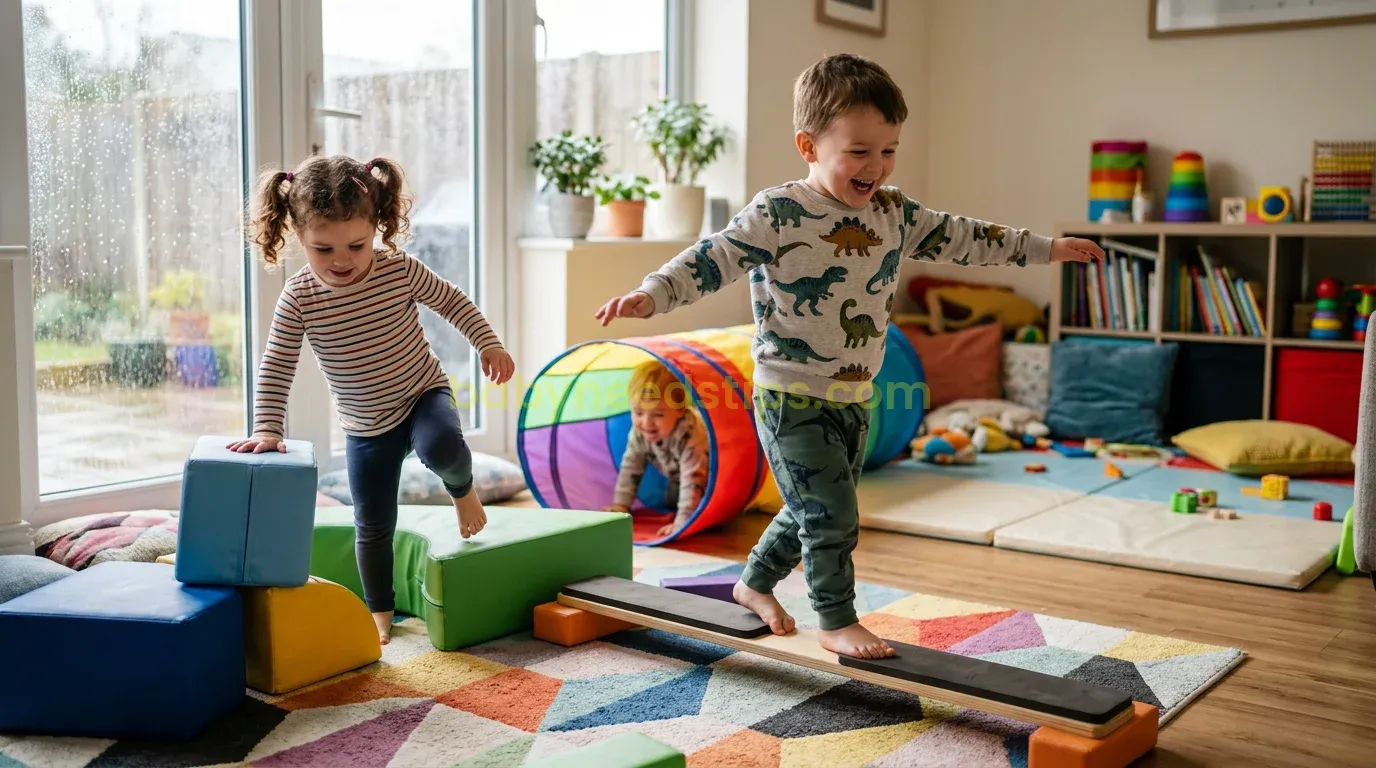
Sometimes you don’t have the energy to build an obstacle course, and that is perfectly okay. In my experience, “Animal Walks” are the most efficient way to burn off high-intensity energy in a small “footprint.” These are specific movements that mimic animals, and they are frequently used in pediatric physical therapy to build core strength.
- The Crab Walk: Sitting on the floor, lifting the hips, and moving using only hands and feet. This is an incredible upper-body strengthener.
- The Bear Crawl: Hands and feet on the floor with hips high (knees off the ground). This targets the shoulders and the core.
- The Frog Jump: Deep squats followed by an explosive jump forward. This is “vigorous activity” that gets the heart rate up quickly.
- The Penguin Shuffle: Standing tall with arms at the sides and toes pointed out, taking tiny, quick steps.
- Washing the “Car”: Give them a spray bottle of water and a cloth to “wash” their plastic ride-on toys or even the baseboards. The squeezing motion of the spray bottle is excellent for hand strength.
- Pillow Plunge: Create a giant pile of pillows and have them “carry” the pillows one by one to a different “fort” location.
- Animal Rescuer: Have them carry “heavy” stacks of board books to “save” them from a “flood” (the rainy floor).
- Painter’s Tape: For lines, mazes, and hopscotch.
- Soft Foam Blocks: For building and “crashing.”
- A “Pop-up” Tunnel: These are cheap, fold flat, and provide endless crawling opportunities.
- Yoga Mat: Provides a non-slip surface for animal walks.
- 08:00 AM: Breakfast & Light Activity (Sorting laundry “Pizza Delivery”).
- 09:30 AM:Vigorous Block (Indoor Obstacle Course – 30 mins).
- 10:30 AM: Snack & Sensory Play (Play-dough or “Baking on the floor”).
- 11:30 AM:Dance Party (Musical Statues – 20 mins).
- 01:00 PM: Nap / Quiet Time.
- 03:00 PM:Animal Walk Challenge (Movement Dice – 15 mins).
- 04:00 PM:Balloon Lava (High-energy, low-impact – 30 mins).
- 05:30 PM: Dinner & “Heavy Work” (Helping clear the table).
A 2026 study in Neuroscience News highlighted that these types of “active parent-child time” are the strongest predictors of a healthy lifestyle because they model movement as a fun, social activity rather than a chore. We suggest making “Movement Dice.” Take a cardboard box, write an animal[6] on each side, and have your toddler roll it. Whatever it lands on, the whole family has to do for 30 seconds. It adds an element of chance and “gamification” that toddlers find irresistible.
The Magic of Music: Dance Parties and Rhythm Games
Music is a physiological “cheat code” for movement. When we hear a beat, our motor cortex—the part of the brain responsible for planning and executing movement—lights up. In my experience, a 15-minute “Dance Party” can provide as much vigorous activity as a trip to the park. For toddlers, music also supports language development through rhythm and repetition.
To make it a “game” rather than just dan[9]cing, try “Musical Statues” (or Freeze Dance). This isn’t just about moving; it’s about “inhibitory control.” The ability to stop a movement mid-stream when the music cuts out is a major developmental milestone in self-regulation. According to the NHS guidelines for under-5s, this type of active play is the best way to develop “agility and coordination.”
Another variation we love is “Mirror Dancing.” Stand face-to-face with your toddler and tell them they are your reflection. Do slow, exaggerated movements—stretching h[3]igh, crouching low, shaking one leg. This encourages “visual-motor integration,” where the child must process a visual cue and translate it into a physical action. In 2026, many parents are utilizing “smart-speaker playlists” specifically designed for toddler movement, which include “Stop and Go” songs that automate these games, allowing you to participate without having to manage the “Pause” button.
Tape Games: Building Balance and Coordination on a Budget
If you have a roll of painter’s tape, you have a gym. In my experience, tape is the most underrated tool for indoor play. Because it is flat, it poses zero tripping hazard, but it provides a “visual boundary” that toddlers find fascinating.
Indoor Hopscotch is a classic. Use the tape to create the traditional grid. Fo[8]r younger toddlers (under 2), don’t worry about the numbers or the “one-foot” rule. Just having them jump into the squares is enough to build “stability and locomotor skills.” For older toddlers (age 3–4), you can introduce the “pebble” (a beanbag or sock ball) to add a layer of fine motor accuracy.
Another great option is “The Maze.” Create a winding path of tape through your hallway. Give your toddler a “task”—perhaps they have to push a toy car along the line or walk it while carrying a spoon with a plastic egg on it. This builds “proprioception,” which is the brain’s ability to understand where the body is in space. A 2025 survey of U.S. parents found that “low-mess, low-prep” games like these were the most likely to be repeated, as they don’t require a massive cleanup after the rain stops.
Heavy Work: Using Chores as Play to Build Muscle
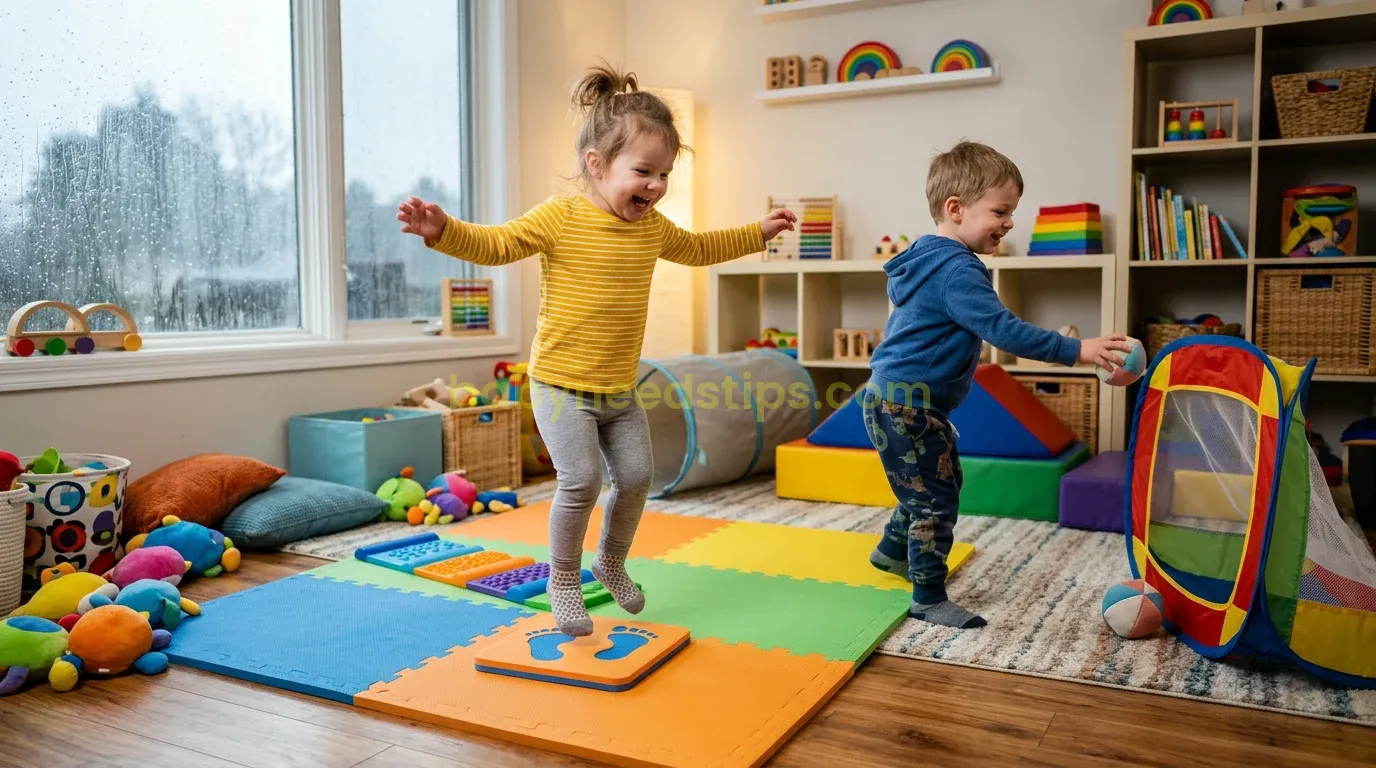
In pediatric occupational therapy, there is a concept called “Heavy Work.” This refers to activities that push or pull against the body, providing deep pressure to the muscles and joints. In my experience, heavy work is the secret weapon for calming a “hyper” toddler. It is incredibly energy-consuming but has a grounding, centering effect on the nervous system.
You don’t need weights; you have laundry. “The Laundry Train” is a favorite in our house. Fill a laundry basket with clothes (or books for extra weight) and have your toddler push it across the carpet. This engage’s the large muscle groups in the legs and core. According to the CDC, “muscle-strengthening” activiti[9]es should be a part of a child’s routine at least three days a week, and pushing a “heavy” basket perfectly fits the bill for a 2-year-old.
Other “Heavy Work” ideas:
Screen Time vs. Active Play: The 2026 Perspective
As we move through 2026, the data on screen time is [10]becoming clearer and more concerning. A study released in January 2026 found that children with the highest screen use (averaging 5 hours a day) could say significantly fewer words than those with limited exposure. Bridget Phillipson, the Education Secretary, recently[11] warned that “passive screen time can start to crowd out the talking, play, and reading that are so important for language development.”
The “Rainy Day Trap” is that we often use screens as[11] a “babysitter” when we are exhausted. While a 20-minute show is fine, it is “displacement time.” Every hour spent sitting is an hour not spent building the “movement motivation” that keeps kids active as they grow. According to the Lurie Children’s 2025 report, 49% [10]of parents rely on screens daily due to childcare challenges, but 60% feel guilty about it.
In my experience, the best way to bridge this gap is “[12]active media.” If you are going to use a screen, use it as a tool for movement. There are countless “Yoga for Kids” or “Action Song” videos that turn the screen into an instructor rather than a distraction. This turns “solitary screen time”—which a March 2026 study linked to behavioral problems—into a social, physical activity.
| Screen Time Metric (2026) | Data Point |
|---|---|
| Avg. Screen Time for 2-year-olds | 127-140 mins/day |
| WHO [13][10]Recommended Max | 60 mins/day |
| % of 4-year-olds with own tablet | 58% |
| Parents using screens for behavior | 71% |
Safety and Equipment: Creating a Worry-Free Environment
Safety is the primary concern when moving “outdoor” energy[7] “indoors.” From what I’ve observed, most indoor injuries on rainy days happen because of “slippery socks” or “sharp corners.” Before starting any of these games, we recommend a “Safety Sweep.”
First, check the footwear. In my experience, bare feet are the safest for indoor play on hardwood or tile, as they provide the best grip. If the house is cold, look for socks with “grippy” silicone bottoms. Second, clear the “Crash Zone.” If you are doing a balloon game or an obstacle course, move coffee tables with sharp edges to the perimeter of the room.
In terms of equipment, you don’t need a “home gym,” but a few “high-impact” items can be helpful:
Note: Always supervise your toddler during physical play. While we encourage “risky play” (climbing, jumping) to build confidence, ensure the environment is “managed-risk” rather than “high-risk.” Consult your pediatrician if you have concerns about your child’s physical development or mobility.
A Sample “Energy-Buster” Rainy Day Schedule
Consistency helps toddlers feel secure, even when their routine is disrupted by weather. In my experience, breaking the “180 minutes” of activity in[9]to small, manageable chunks makes the day go faster for everyone.
This schedule provides nearly 100 minutes of “structured” active play, which, when combined with the natural movement of a toddler’s day, easily hits that 180-minute goal.
*
Key Takeaways for Rainy Day Play
* The 3-Hour Rule: Toddlers need 180 minutes of movement daily; don’t let the rain stop the clock.
* Low Tech is High Impact: Balloons and painter’s tape are often more effective than expensive toys.
* Heavy Work Calms: Activities that involve pushing or pulling (like a laundry basket) help regulate energy levels.
* Screen Swap: If you use screens, choose “active media[3]” that requires the child to jump, dance, or move along.
* Parental Participation: You are the best toy. Your engagement is the strongest predictor of their future fitness.
*
FAQ: Indoor Play & Toddler Energy
Q: My toddler seems “hyper” even after an hour of play. What am I doing wrong?
A: In my experience, you aren’t doing anything wrong. High energy is often a sign of “sensory seeking.” If jumping isn’t working, try “Heavy Work” (pushing things) or “Proprioceptive Input” (deep pressure, like a “burrito wrap” in a blanket). This often “grounds” the nervous system better than just running.
Q: We live in a small apartment. Can I still do an obstacle course?
A: Absolutely. “Verticality” is your friend. Use the space under the table as a tunnel and the couch as a “mountain.” Even a path of tape down a 5-foot hallway can be a “tightrope” or a “lava jump.”
Q: Is “The Floor is Lava” safe for a two-year-old?
A: We recommend a “Safe Version.” Instead of jumping between furniture (which is a fall risk), use “lily pads” made of non-slip mats or cushions on the floor. The “lava” is just the carpet. This keeps the height low but the fun high.
Q: How do I handle a toddler who won’t stop “crashing” into things?
A: “Crashing” is actually a form of sensory feedback. Instead of stopping it, provide a safe place for it. Create a “Crash Pad” using a pile of blankets and pillows and make it a game: “Can you do a bear crawl and then crash into the pillows?”
Q: What if I’m too tired to play?
A: We’ve all been there. This is when “Stationary Games” come in. Sit on the couch and be the “Ref.” Use a timer and say, “How many times can you run to the front door and back before the timer goes off?” or “Show me your best frog jump!” You provide the engagement; they provide the energy.
*
Conclusion
Rainy days don’t have to be a sentence to sedentary behavior. By shifting our perspective from “managing a bored child” to “facilitating a developmental workout,” we can transform our homes into spaces of growth. As we have seen from the data in 2026, the movements your toddler makes today—the silly dances, the tape-line walks, the heavy laundry pushes—are the building blocks for a healthy, active adolescence. So, grab a balloon, clear the “Crash Zone,” and remember: in the world of a toddler, there is no such thing as “stuck inside”—there is only “an indoor adventure waiting to happen.”