
Navigating the Early Journey: Recognizing Red Flags of Autism in Toddlers in 2026



When you first notice that your child might be developing differently than their peers, it can feel like standing at the edge of a vast, unfamiliar territory. In my years of analyzing developmental data and speaking with families, I have seen that the most powerful tool a parent possesses is not just love, but informed intuition. As of April 2026, the landscape of autism spectrum disorder (ASD) has shifted significantly, with new diagnostic tools and a better understanding of how the condition manifests in early childhood.
In this guide, I will walk you through the current “red flags” that shouldn’t be ignored, supported by the latest 2026 statistics and research. From subtle shifts in social engagement to the rise of AI-assisted screening, understanding these signs is the first step toward unlocking the support your child needs to thrive.
The Current Landscape: Understanding the 2026 Autism Statistics
According to the CDC’s most recent 2025 and 2026 community reports, the prevalence of autism has reached an all-time high. The data indicates that approximately 1 in 31 children (3.2%) in the United States are identified with ASD by age 8. This is a dramatic increase from two decades ago, when the rate was roughly 1 in 150. In my observation, this surge doesn’t necessarily mean a “new epidemic”; rather, it reflects a society that is finally getting better at seeing and supporting neurodivergent children.
The 2026 data also reveals a narrowing gap in racial and ethnic disparities. For the first time, prevalence among Black (3.7%), Asian/Pacific Islander (3.8%), and Hispanic (3.3%) children has approached or exceeded that of White children (2.8%). This suggests that outreach programs and screening initiatives in underserved communities are finally yielding results. However, the gender gap remains persistent: boys are still 3.4 times more likely to be diagnosed than girls, with identification rates of 4.9% and 1.4% respectively.
Table 1: 2026 Autism Prevalence by Demographic (CDC Data)
| Demographic Group | Identification Rate (Approx. %) | Ratio/Context |
|---|---|---|
| All 8-Year-Olds | 3.2% | 1 in 31 children |
| Boys | 4.9% | 3.4x more likely than girls |
| Girls | 1.4% | Often underdiagnosed due to subtler signs |
| Asian / Pacific Islander | 3.8% | Highest identification rate in 2026 |
| Black (Non-Hispanic) | 3.7% | Significant increase due to better outreach |
| White | 2.8% | Reflects consistent screening access |
| U.S. Adults | 2.2% | Est. 5.4 million adults on the spectrum |
From what I’ve observed, these numbers highlight why early detection is no longer just a recommendation—it is a public health priority. With millions of families navigating this journey, you are far from alone.
Social Communication Red Flags: Looking Beyond the Surface
In my experience, the earliest indicators of autism often aren’t “bad behaviors,” but rather the absence of expected social milestones. Experts like Dr. Ami Klin, director of the Marcus Autism Center, have emphasized that autism is essentially a difference in how a child’s brain prioritizes social information.
One of the most critical red flags is a lack of “joint attention.” By 12 to 14 months, most toddlers will point at an airplane in the sky or a dog in the park, then look back at you to see if you’re seeing it too. They are sharing an experience. A toddler on the spectrum may not point at objects of interest or, conversely, may not look where you are pointing.
Another major indicator is the “response to name.” Research from the 2025 Capital Area Pediatrics guide notes that a lack of response to their name by 12 months is a significant warning sign. While a neurotypical child might be distracted, they will eventually turn. A child at risk for ASD may seem as though they have hearing loss, even when their hearing is perfect. They may also show limited or no eye contact, often looking “through” people rather than at them, or failing to share warm, joyful expressions like smiling back when you smile at them.
Language Development: Monitoring Speech Milestones at 12, 18, and 24 Months
When I talk to parents, speech delay is often the concern that first brings them to a pediatrician’s office. However, it’s important to distinguish between a “late bloomer” and a child showing signs of autism. According to the American Academy of Pediatrics’ 2025-2026 guidelines, specific speech-related red flags include:
- 12 Months: No babbling or using “social chatting” sounds.
- 16 Months: No single words spoken.
- 24 Months: No two-word spontaneous phrases (not just repeating what they hear).
- Any Age: Any loss of previously acquired language or social skills.
This last point—regression—is perhaps the most urgent red flag. If your child was saying “Mama” or “Dada” at 12 months but has stopped by 18 months, specialists recommend an immediate evaluation. We’ve seen that about 25-30% of children with autism experience this type of regression, often between 15 and 24 months.
Furthermore, pay attention to how your child communicates. Do they use your hand as a tool? For example, instead of pointing to a jar of cookies, they might grab your hand and pull it toward the jar without making eye contact. This “hand-leading” is a common non-verbal communication pattern in toddlers with autism.
Repetitive Behaviors and Restricted Interests
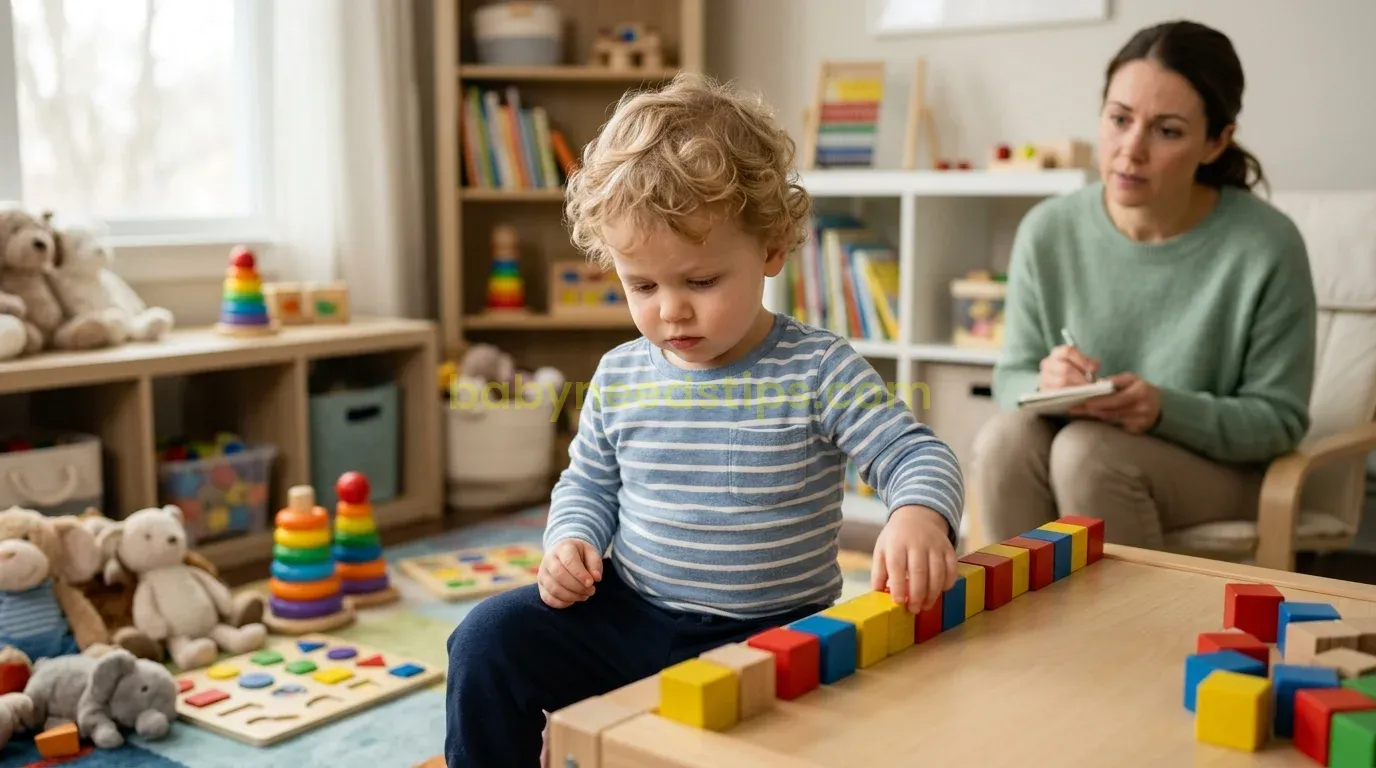
By age two, many toddlers develop “rituals,” but in children with autism, these behaviors are often more intense and interfere with daily life. In my review of the 2026 National Autism Center guidelines, these behaviors are categorized as restricted, repetitive patterns.
Common signs include “stereotypy,” such as hand flapping, rocking, or spinning in circles. You might also notice an unusual way of playing with toys. Instead of pushing a toy car, a toddler might flip it over and spend an hour spinning the wheels, fascinated by the motion rather than the “pretend” use of the car.
Sensory sensitivities are also a major factor. As of 2026, we understand more about how the autistic brain processes environment stimuli. A child might have an extreme reaction to the sound of a vacuum cleaner or the texture of certain clothes (like shirt tags). Conversely, they might have an unusually high pain threshold or an intense need to sniff objects. If you notice your child consistently lining up toys in a precise order and becoming extremely distressed if one is moved, this is a clear signal to seek a professional opinion.
The New Frontier of Screening: AI and Tablet-Based Tools
One of the most exciting developments I’ve seen in 2026 is the integration of Artificial Intelligence into early screening. Traditional screening, like the Modified Checklist for Autism in Toddlers (M-CHAT) used at 18- and 24-month well-child visits, relies on parent questionnaires which can sometimes be subjective.
In 2026, tools like the “SenseToKnow” app, developed at Duke University, are changing the game. This tablet-based app uses AI to track a child’s eye movements, facial expressions, and even the force they use when popping digital bubbles on the screen. According to a 2024 study published in JAMA Network Open, AI models like “AutMedAI” can now predict autism risk in children under 24 months with nearly 80% accuracy using simple medical and background data.
As IEEE Senior Member Dheerendra Panwar noted in early 2026, “AI excels at identifying subtle behavioral patterns that humans may overlook… ensuring more consistent and objective early diagnoses.” While these tools are not meant to replace a doctor, they provide you with data-driven evidence to bring to your pediatrician.
Why Early Intervention Matters: The Brain’s Neuroplasticity
I often hear parents ask, “Why do we need a diagnosis so early? Can’t we just wait and see?” The answer lies in neuroplasticity. Between the ages of birth and three, the human brain is at its most adaptable.
As stated by experts from the Eunice Kennedy Shriver National Institute of child Health and Human Development in 2025, early intervention can significantly improve a child’s long-term outcomes, sometimes to the point where they no longer meet the criteria for an autism diagnosis later in life. By engaging in targeted therapies like Applied Behavior Analysis (ABA), speech therapy, or occupational therapy while the brain is still forming its core neural pathways, you are giving your child the best chance to build essential communication and social skills.
Starting intervention by age 2 or 3, rather than waiting until school age, can lead to higher IQ scores and better adaptive behavior. In the words of Krista Orellana, BCBA: “An autism diagnosis doesn’t change who your child is—it helps clarify how to best support them.”
Navigating the Evaluation Process: A Step-by-Step Guide
If you’ve spotted several red flags, the next step is a formal evaluation. From what I’ve observed in 2026, this process can be daunting due to long waitlists, which often stretch from 6 to 18 months in many U.S. regions.
The process typically involves:
- Pediatrician Screening: Your doctor should use the M-CHAT or a similar tool. If the screen is “positive,” they should refer you to a specialist.
- Specialist Evaluation: This usually involves a multidisciplinary team, including a developmental pediatrician, a child psychologist, and often a speech-language pathologist.
- Gold-Standard Testing: Expect tools like the Autism Diagnostic Observation Schedule (ADOS) or the Autism Diagnostic Interview-Revised (ADI-R).
- Medical Tests: To rule out other conditions, the doctor may recommend hearing tests or genetic testing.
- Document Everything: Keep a journal or take videos of the behaviors that concern you. This is invaluable for specialists who only see your child for a short window.
- Use an App: Download a tool like ASDetect or look into the SenseToKnow platform to get a preliminary digital screen.
- Schedule the “Well-Child” Plus: Don’t just wait for the next physical. Call your pediatrician and specifically request a “developmental screening.”
- Contact Your State’s Early Intervention Office: You do not need a doctor’s referral to have your child evaluated for state-funded early intervention services (Ages 0-3).
- Seek Community: Join a local or online support group. The 2026 autism community is more connected than ever, and peer advice is often just as helpful as professional guidance.
My advice? Don’t wait for the formal diagnosis to start seeking support. Many states have “Early Intervention” (Part C) programs that provide services based on developmental delay, even before an official autism diagnosis is confirmed.
The Financial Reality: Managing Therapy Costs and Insurance in 2026
We cannot ignore the financial weight of an autism diagnosis. According to reports from Achievement Behavior Services and Kids Club ABA for 2026, the cost of therapy is substantial. Hourly rates for Applied Behavior Analysis (ABA) range from $120 to $150. For a child receiving 20 hours of therapy per week, the annual cost can exceed $124,000 without insurance.
Table 2: 2026 Estimated Annual Costs of Autism Support (Before Insurance)
| Service Type | Hourly Rate (Avg) | Annual Cost (Intensive) |
|---|---|---|
| ABA Therapy | $120 – $150 | $62,400 – $156,000 |
| Speech Therapy | $100 – $250 | $5,200 – $13,000 (1hr/wk) |
| Occupational Therapy | $100 – $200 | $5,200 – $10,400 (1hr/wk) |
| Specialized Childcare | N/A | $15,000 – $30,000 |
| Total Healthcare | N/A | $60,000+ (Total family impact) |
Disclaimer: These are 2026 estimates based on current market trends. Always consult with your insurance provider and local state agencies for actual out-of-pocket costs.
The good news is that most private insurance plans and Medicaid now cover ABA as an essential health benefit. In states like New York and Georgia, mandates require coverage for children until age 21. Many families find their actual out-of-pocket costs drop to between $0 and $20,000 annually once deductibles and copays are met.
Confronting Myths and Managing the Emotional Impact
Receiving a diagnosis—or even just suspecting one—triggers a whirlwind of emotions. I’ve seen parents experience everything from relief (“Finally, an explanation”) to grief for the “typical” childhood they imagined. In 2026, the conversation has moved away from seeing autism as a tragedy toward seeing it as a “different way of looking at the world,” as Dr. Arif Khan, a pediatric neurologist, shared in a recent address.
One myth that stubbornly persists is the link between vaccines and autism. Let me be clear: scientific data as of 2026 continues to show no link between the two. Another misconception is that all autistic children have “savant” skills. While some do, the spectrum is vast, and every child’s profile is unique.
As you navigate this, remember the words of Mallary S., a parent of two autistic children: “An autism diagnosis doesn’t change who your child is… finding partners who understand their individual needs made a monumental change in our lives.”
Proactive Steps: What to Do If You Suspect Your child Is at Risk
If you are reading this and nodding your head at the descriptions of joint attention or repetitive play, here is your checklist for action:
*
Key Takeaways Box
*
FAQ
Q: At what age can autism be reliably diagnosed in 2026?
A: While the median age of diagnosis is still around 47 months, specialists can now reliably diagnose autism in toddlers as young as 18 to 24 months. Some AI-assisted screenings are even identifying risk factors in infants under 12 months.
Q: Is “profound autism” a different diagnosis?
A: As of 2026, “profound autism” is a term used to describe individuals who require 24/7 care and have significant intellectual or communication challenges. It is still under the umbrella of Autism Spectrum Disorder (ASD) in the DSM-5, but it helps clinicians tailor higher-intensity support.
Q: What is the first thing I should do if my 18-month-old isn’t talking?
A: First, check for other social markers: do they point to things? Do they make eye contact? Then, schedule a hearing test and a developmental screening with your pediatrician. Speech delay alone isn’t always autism, but it is a primary “red flag.”
Q: Does insurance cover 40 hours of therapy a week?
A: Many plans do, provided a BCBA (Board-Certified Behavior Analyst) determines it is “medically necessary.” In 2026, most states require insurers to cover evidence-based treatments like ABA without an annual dollar cap.
Q: Are girls really less likely to have autism?
A: Boys are diagnosed about 3.4 times more often, but many experts believe girls are underdiagnosed because they often “mask” or show subtler social difficulties. In 2026, clinicians are becoming better at identifying these “female phenotypes” of autism.
*
Disclaimer: I am a research journalist, not a medical professional. This article is for informational purposes only. If you have concerns about your child’s development, please consult with a qualified pediatrician or developmental specialist.