15 Easy Fine Motor Skills Activities for Toddlers Using Household Items (2026 Guide)


In the rapidly evolving parenting landscape of 2026, the shift toward “edutainment”—the intersection of education and entertainment—has reached a fever pitch. As a research journalist and a parent who has navigated the post-pandemic developmental shifts, I have seen firsthand how the focus has moved from flashy, tech-heavy toys back to the tactile, foundational basics found right in our kitchen drawers. According to a March 2026 report from Business Research Insights, the global children’s toy market is valued at a staggering $125.33 billion. Yet, despite this massive commercial growth, a growing number of parents—approximately 58% in the United States, per 2026 Grand View Research data—are actively seeking ways to build specific skill sets without breaking the bank.
Fine motor skills, the small but precise movements of the hands, fingers, and wrists, are the silent engine of a child’s independence. From zipping a jacket to holding a pencil in a tripod grasp, these skills form the bedrock of academic and daily success. In my experience, you don’t need a $200 “smart” activity cube to foster these abilities. In fact, some of the most effective developmental tools are likely sitting in your recycling bin or pantry right now. This guide provides 15 evidence-based, easy-to-implement activities using household items to boost your toddler’s dexterity and coordination.
*
Key Takeaways
- The 2026 Developmental Shift: While the toy market is worth over $125 billion, 58% of U.S. parents now prioritize skill-building over high-tech features.
- The Power of the Pincer Grasp: Developing the thumb-and-finger grasp is a major neurological milestone that predicts later handwriting and self-feeding success.
- Sustainability Meets Science: Using “used materials” like cardboard and plastic bottles is clinically proven (via the AHEMD-IS scale) to promote motor development.
- Cost-Effective Learning: Household items provide the same (or better) resistance and tactile feedback as expensive therapeutic tools.
- Safety First: Always supervise toddlers with small items like coins, buttons, or dry pasta to prevent choking hazards.
*
1. Why Fine Motor Skills Matter More Than Ever in 2026
In my observations of early childhood trends over the last few years, the definition of “preparedness” for kindergarten has shifted. As we navigate the middle of this decade, pediatricians are increasingly emphasizing that fine motor proficiency is not just about writing; it is a mediator for cognitive and social development. According to research from the SPHeRE Programme updated for 2026, children in primary school spend between 30% and 60% of their day on tasks requiring fine motor skills. However, a concerning 36% of children are currently entering their school years with below-average fine motor proficiency.
This gap has led to a resurgence of interest in “home affordances”—a term coined by developmental experts like Priscila Caçola at the University of Texas at Arlington. In my experience, the home environment is a rich laboratory for these skills. When a child manipulates a household object, they aren’t just playing; they are strengthening the intrinsic muscles of the hand. This strength is what allows them to eventually move from a “raking grasp” (using the whole hand) to a “pincer grasp” (using the thumb and index finger).
Furthermore, recent 2025/2026 reports from the Johns Hopkins Children’s Center indicate that while gross motor skills remained steady post-pandemic, there have been slight declines (around 2-3%) in areas involving communication and problem-solving. Fine motor activities using household items bridge this gap by requiring toddlers to solve spatial puzzles—how to fit a coin in a slot or how to thread a noodle—thereby boosting executive function alongside physical dexterity.
2. The Economy of Play: Why You Don’t Need Expensive Toys
When you walk down the toy aisle in 2026, the price tags can be intimidating. With North America dominating 33.8% of the global toy market share as of 2025, the average U.S. household spending on entertainment-related devices has reached record highs. However, in my experience, the most “premium” developmental tools are often free. Data from Fortune Business Insights shows that while the market for educational and licensed toys is growing at a CAGR of 7.16%, price sensitivity is also a major market impediment.
This economic reality has driven the “Used Material Movement.” A 2025 literature review published by Journals UMS analyzed 65 research papers and concluded that using “used goods” like cardboard boxes, plastic bottles, and old fabric can significantly increase a child’s fine motor knowledge and actions. The beauty of household items lies in their variety. A plastic bottle provides resistance when squeezed; a cardboard box offers a sturdy surface for punching holes; a handful of dry beans provides tactile feedback that a digital screen simply cannot replicate.
We recommend that you look at your home through the lens of a therapist. Occupational therapist Kelsey Flack often reminds parents that they don’t need fancy tools. Her “therapy cabinets” are filled with basic items like clothespins and sponges because they provide the exact resistance needed to build hand strength. By opting for these activities, you are not only saving money but also teaching your child about sustainability and creative problem-solving.
3. Understanding the 2026 Pediatric Milestones
To effectively use household items, you must first understand what your child is capable of at different stages. The 2026 Ability Innovations report outlines clear fine motor milestones that we should look for. In my experience, knowing these “goals” makes the activities feel more purposeful.
For toddlers aged 1–2 years, the focus is on basic containment and stacking. They should be able to stack at least three blocks and turn the thick pages of a board book. Between 2–3 years, the complexity increases significantly. This is the “golden age” for threading and snipping. A 3-year-old should be able to string 3–4 large beads and begin to use safety scissors to snip the edges of paper.
By the time a child reaches 4–5 years, they should be transitioning to a tripod grasp on a pencil and coloring within lines. If you notice your child struggling to meet these milestones, using the household activities listed below can serve as a gentle, low-pressure intervention. As always, consult your pediatrician or an occupational therapist if you have concerns about significant delays, as early intervention is key to long-term success.
Table 1: Fine Motor Developmental Milestones (2026 Data)
| Age Range | Expected Fine Motor Skill | Household Activity Equivalent |
|---|---|---|
| 12–18 Months | Stacks 2–3 blocks; Scribbles with crayon | Stacking plastic cups; Drawing in a salt tray |
| 18–24 Months | Turns 3 pages at a time; Places pegs in holes | Turning cereal box flaps; Pushing straws into a lid |
| 2–3 Years | Strings 3–4 beads; Snips with scissors | Threading dry pasta; Cutting playdough with a plastic knife |
| 3–4 Years | Copies a circle; Buttons large buttons | Tracing shapes in flour; Fastening old shirts |
| 4–5 Years | Tripod grasp; Colors inside lines | Using tweezers to sort beans; Paint with Q-tips |
Source: Compiled from 2026 reports by Ability Innovations and Lurie Children’s Hospital.
4. Activity 1-3: The Pincer Grasp Powerhouse
The pincer grasp is the “Holy Grail” of toddler motor development. It involves the coordination of the thumb and index finger to pick up small objects. In my experience, this is the skill that parents notice first—often when their child successfully picks up a single Cheerio from a high-chair tray.
1. The “Cheerio” or Pasta Threading: Take a piece of dry spaghetti and stick it upright into a ball of playdough or a piece of Styrofoam. Ask your child to thread dry Cheerios or hollow pasta (like penne or rigatoni) onto the noodle. This requires intense visual-motor coordination. As a 2026 Specially Gifted Foundation report notes, “cereal jewelry” is one of the most effective at-home ways to build dexterity.
2. The Coin Slot Challenge: Find an empty plastic container (like a yogurt tub or an old coffee creamer bottle) and cut a thin slit in the lid. Provide your child with large buttons or play coins and encourage them to “mail” the coins into the slot. This activity works on wrist rotation and precision. I’ve found that using different sized slots for different sized items (like cardboard “envelopes”) keeps the challenge fresh.
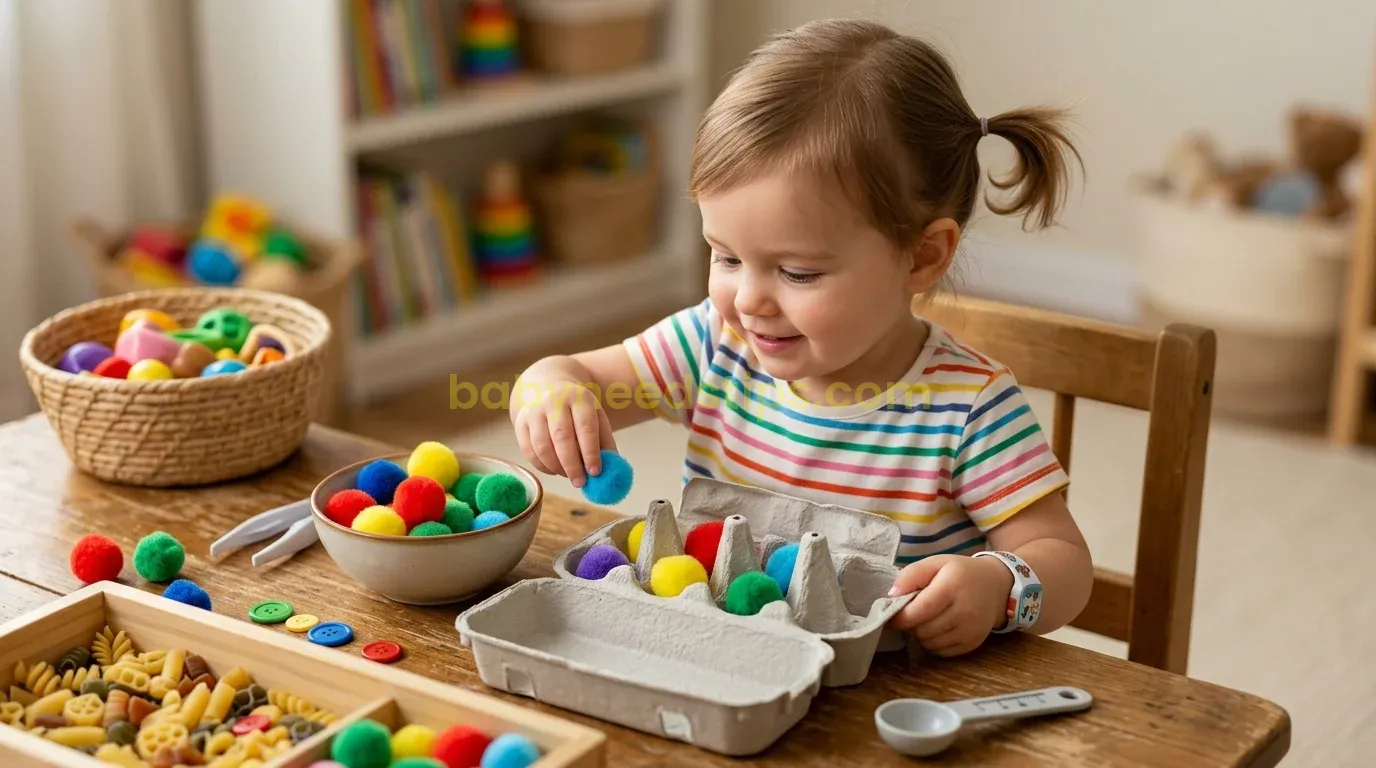
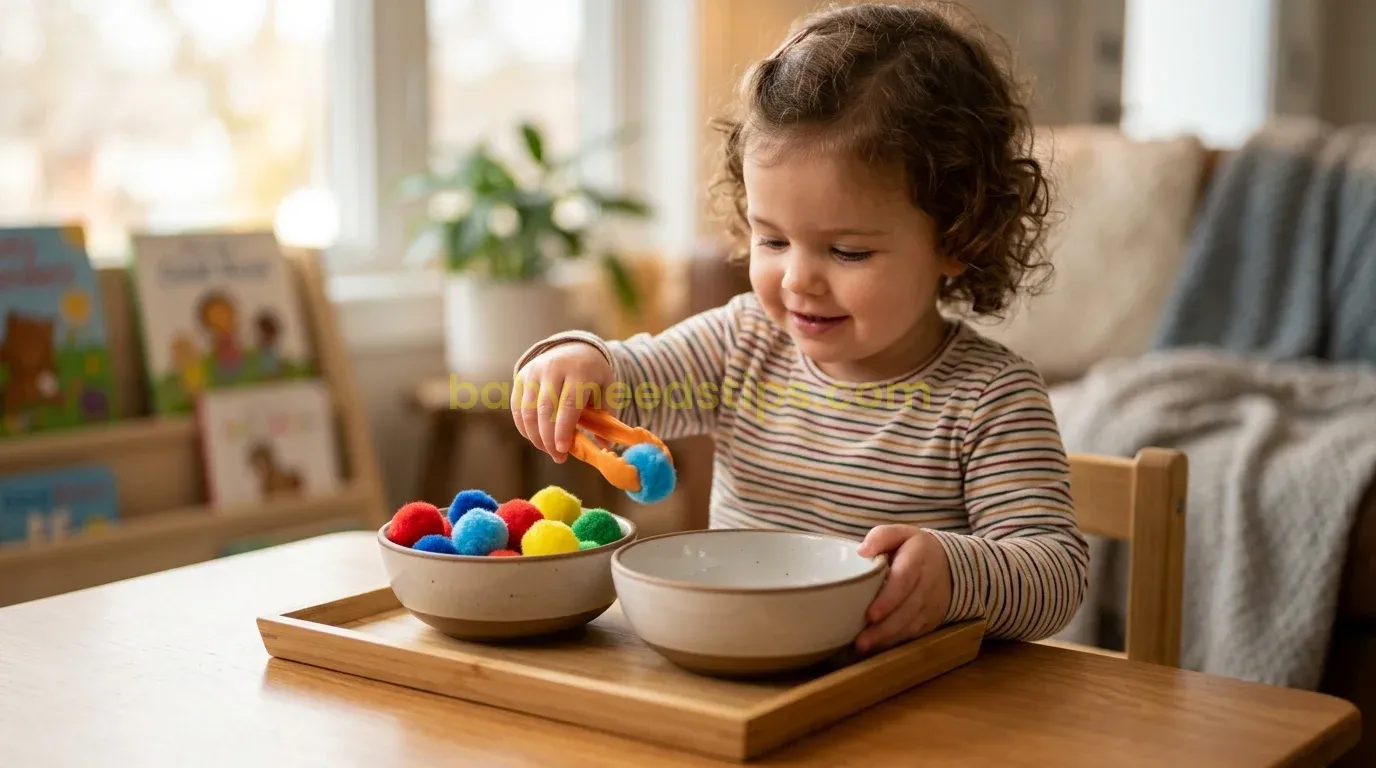
3. Tweezing for Treasure: Use a pair of large kitchen tongs or plastic tweezers (often found in old board games). Scatter small items like cotton balls, pom-poms, or even dry beans into one bowl. Have your child transfer them into an empty egg carton. According to Hillsboro Health, this mimics the “Bed Bugs” therapy game and is excellent for building the hand muscles needed for future scissor use.
5. Activity 4-6: Strength and Resistance
While precision is important, hand strength is what allows a child to maintain a grip on a pencil or open a heavy door. I’ve found that toddlers love activities that allow them to use their full hand power, often referred to as the “power grasp.”
4. The Sponge Squeeze: This is a classic “wet” activity that is perfect for high-chair time or the bathtub. Give your child two bowls—one full of water and one empty. Provide a standard kitchen sponge and show them how to soak it in the full bowl and then squeeze the water into the empty one. The resistance of the wet sponge is a fantastic muscle builder. As noted in the More to Say CT 2025 guide, squeezing water strengthens the small muscles in the wrists and hands.
5. Spray Bottle “Mist”: Fill a small, clean spray bottle with water. Let your toddler “water” your indoor plants or even spray the windows (which you can then “wipe” together). The act of pulling the trigger works the entire hand and is a precursor to the finger strength needed for using a hole punch or heavy-duty fasteners.
6. Newspaper Crumple and Tear: In my experience, the simplest activities are often the best. Give your child old newspapers or junk mail. Show them how to tear the paper into long strips and then crumple those strips into tight balls. These “paper balls” can then be used as “ammunition” for a bean-bag toss into a laundry basket. TheraKids recommends this for building “intrinsic hand strength,” which is vital for dexterity.
6. Activity 7-9: Coordination and Spatial Awareness
Spatial awareness—the ability to understand where your body and objects are in space—is a critical component of fine motor control. These activities focus on the “eye-hand” connection.
7. The Colander Pipe Cleaner Poke: Turn a kitchen colander upside down. Give your child a handful of pipe cleaners (or even dry spaghetti, though it’s more fragile) and have them poke the items through the holes. This activity requires your child to align the object with a small target, significantly boosting hand-eye coordination. In 2026, many educators refer to this as “loose parts play,” which Edutopia suggests improves numeracy and executive function.
8. Tape Rescue: This is a personal favorite because it keeps toddlers engaged for a long time. Take several of your child’s toy animals or cars and tape them to a cookie sheet using masking tape or painter’s tape. Your child must find the edge of the tape and use their fingernails and fingertips to “rescue” the toys. This works the pincer grasp and requires problem-solving as they figure out how to peel the tape back.
9. Rubber Band Wrap: Take a sturdy household object, like a canned food item or a plastic water bottle. Give your child several thick rubber bands and show them how to stretch them and slide them onto the container. The resistance of the rubber bands provides excellent “proprioceptive input”—the feeling of muscle exertion—which helps the brain understand how much force is needed for various tasks.
7. Activity 10-12: Precision Tools and Art
Artistic endeavors naturally integrate fine motor practice. In 2026, the focus is on “process art”—where the act of creating is more important than the final product.
10. Q-Tip Painting: Instead of a large, chunky paintbrush, give your child a Q-tip. This forces them to use a “tripod grasp” (holding the stick between the thumb and first two fingers) rather than a “fisted grasp.” They can dip the Q-tip in washable paint and make “dot art.” This is a high-precision activity that prepares them for writing letters.
11. Sticker “Peel and Stick”: I’ve found that a simple sheet of stickers can be a 20-minute developmental workout. Peeling the sticker off the sheet requires high-level finger dexterity. Have your child place the stickers inside drawn circles or along a line to add an element of visual-spatial control. Lurie Children’s lists this as a key milestone for 2-year-olds.
12. The Salt Tray Trace: Pour a thin layer of salt, flour, or cornmeal into a cookie sheet. Use a crayon or a finger to draw a shape or a letter in the tray and ask your child to copy it. This provides tactile feedback that “vibrates” through the fingertips, helping the brain encode the movement patterns for letters and numbers.
8. Activity 13-15: Functional Independence
Ultimately, we want our children to use these skills to take care of themselves. In my experience, integrating fine motor work into daily chores is the most sustainable way to practice.
13. Button and Zip Station: Take an old shirt with large buttons or a jacket with a chunky zipper. Instead of having your child practice while wearing the clothes (which can be frustrating), lay the clothes flat on the floor. Let them practice buttoning and unbuttoning at their own pace. Ability Innovations (2026) notes that by age 3-4, children should be able to fasten large buttons independently.
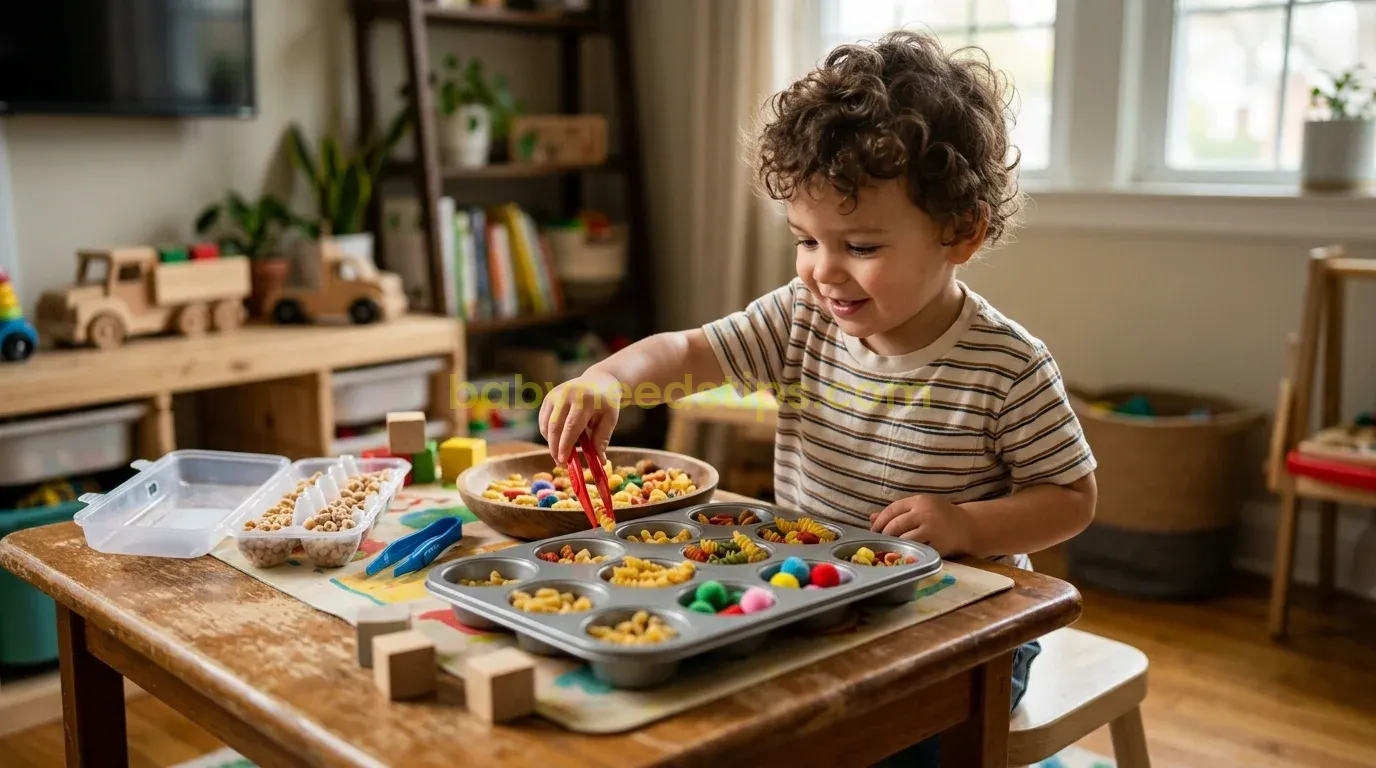
14. The “Muffin Tin” Sort: Use a muffin tin as a sorting tray. Provide a bowl of mixed household items—large buttons, different shaped pasta, or colored pom-poms. Ask your child to sort them into the tin “cups” by color or shape. Using a small spoon to transfer the items adds an extra layer of difficulty, working on the wrist stability needed for self-feeding.
15. Playdough “Scissors”: Before you give a child paper to cut, give them playdough. Roll the dough into “snakes” and have your child use safety scissors to “snip” the snake into small pieces. The dough provides more resistance than paper, making it easier for the child to feel the “open-close” motion of the scissors. According to the 2026 I’m The Chef Too report, this “edutainment” approach turns a mundane skill into a sensory adventure.
Table 2: Household Item Activity Cheat Sheet
| Household Item | Fine Motor Target | Skill Developed |
|---|---|---|
| Kitchen Tongs | Transferring pom-poms | Grip strength & precision |
| Masking Tape | Peeling from a table | Fingertip dexterity |
| Colander | Pushing pipe cleaners | Hand-eye coordination |
| Spray Bottle | Misting plants | Hand muscle endurance |
| Yogurt Tub | Pushing coins through a slot | Wrist rotation |
| Old Buttons | Sorting into muffin tins | Pincer grasp & categorization |
Source: Compiled from OT Perspective and Hillsboro Health 2025/2026 guides.
9. Safety and Sustainability in 2026
While using household items is highly effective, it does come with a set of responsibilities. In my experience, safety is the primary concern when dealing with toddlers and small objects.
Safety Disclaimer:The activities listed in this article involve small items (coins, buttons, dry pasta) that pose a significant choking hazard. Never leave a child unattended during these activities. Always ensure that the items used are clean and free of sharp edges. Consult your doctor or a professional therapist before beginning any new developmental program if your child has underlying medical conditions.
From a sustainability perspective, the “AHEMD-IS” (Affordances in the Home Environment for Motor Development-Infant Scale) has become a gold standard in 2026 for assessing how homes can promote growth. By repurposing items like plastic bottles and cardboard, you are reducing the environmental footprint of “disposable” plastic toys. Research from the University of Texas at Arlington underscores that many parents are unaware of how a simple coffee table or an empty egg carton can be a developmental catalyst. We recommend that you create a “Fine Motor Kit”—a simple bin filled with these household “loose parts”—so that you always have a developmental activity ready to go.
10. Conclusion: Building a Foundation for the Future
As we look at the children of 2026, it’s clear that their success in a digital world still depends on the analog strength of their hands. Writing a name, coding on a keyboard, or performing surgery—all of these advanced human activities begin with a toddler picking up a piece of pasta or squeezing a sponge.
In my journey as a researcher, I have found that the most resilient and capable children are those who were given the “affordance” to explore their environment. You don’t need a massive budget to provide your child with a world-class developmental education. By using these 15 easy activities, you are turning your home into a center of learning. Remember, as expert Priscila Caçola says, “Motor development is the mediator of cognitive, social, and emotional development.” When you strengthen those small hands, you are opening the door to a much larger world of potential.
*
Expert Quotes
“Good motor skills predict a whole lot later in life. Developing a child’s motor skills is extremely important because motor development is actually the mediator of cognitive, social, and emotional development.”
— Priscila Caçola, PhD, Associate Professor at UT Arlington (Source: ScienceDaily / AHEMD-IS Study)
“As a therapist, I often hear people say, ‘I don’t have all of those expensive toys that you do.’ I am here to tell you, you don’t need fancy toys! My cabinets are full of basic household items to work on fine motor skills.”
— Kelsey Flack, Occupational Therapist (Source: Hillsboro Health)
*
FAQ Section
Q1: At what age should I start these fine motor activities?
A: You can begin simple activities as early as 9–12 months. For example, the “Container Drop” (putting large items into a tub) is appropriate for infants. By 18–24 months, you can introduce more complex tasks like tape peeling and coin slots.
Q2: My child still uses their whole hand to pick things up. Is this a problem?
A: Not necessarily. This is called a “raking grasp” and is normal for younger toddlers. The activities in this guide, specifically the pincer grasp activities (Activity 1-3), are designed to help them transition to using their thumb and index finger.
Q3: How long should we practice these activities each day?
A: Toddlers have short attention spans. In my experience, 5–10 minutes of “purposeful play” once or twice a day is plenty. The goal is to keep it fun and engaging, not to make it feel like “work.”
Q4: Can these activities help with my child’s speech development?
A: Interestingly, yes. According to 2025 research from Edutopia, fine motor coordination is linked to executive function and cognitive tasks. The problem-solving required to thread a bead or sort an item involves the same brain regions used for early language and numeracy.
Q5: What if my child is frustrated by an activity?
A: If an activity is too hard, simplify it. For example, if threading small pasta is too difficult, use large curtain rings or even toilet paper rolls. Success breeds confidence, which encourages the child to keep practicing.
Q6: Is it okay to use digital “fine motor” games on a tablet?
A: While swiping and scrolling are 21st-century fine motor skills, they do not build the same muscle strength or tactile “feedback” as physical objects. We recommend that the majority of fine motor practice be tactile and 3D.
Q7: How do I know if my child needs professional Occupational Therapy (OT)?
A: If your child is significantly behind the 2026 milestones (e.g., cannot stack two blocks by age 2 or cannot hold a thick crayon), or if they seem to avoid using one hand entirely, consult your pediatrician for a referral to a licensed OT.