
Gentle Parenting Tantrums: How to Stay Calm When Your Toddler Melts Down



In my experience as a parent navigating the early childhood years in 2026, few things are as emotionally taxing as the sudden, explosive transition from a happy toddler to a full-blown floor-drumming meltdown. You know the scene: one minute you’re picking out organic blueberries, and the next, your two-year-old is reacting to a broken cracker as if it were a national tragedy. If you find yourself holding back your own tears while your child screams in the middle of a Target aisle, you are not alone. According to a March 2026 report from ResearchGate, 40.4% of toddlers experience tantrums on a daily basis, with 94.3% of those episodes manifesting as shouting and 92.2% as crying.
The parenting landscape of 2026 has shifted significantly. While “Gentle Parenting” reached its peak cultural saturation in late 2025, we are now seeing a more nuanced approach. We’ve moved past the “never say no” era into what many experts now call “Boundaries with Empathy.” Data from Talker Research (September 2025) indicates that while 38% of parents still identify with the gentle parenting label, nearly 37% have transitioned into “Cycle-Breaking” parenting—a style that prioritizes healing generational trauma while maintaining firmer structures.
Staying calm isn’t just about “being nice.” It is a physiological requirement for the brain-building work of toddlerhood. As we explore the latest 2026 data and strategies, remember that your calm is the thermostat for your child’s emotional climate. If you are struggling to keep your cool, this guide will provide the science-backed tools and current statistics you need to navigate the storm without losing your mind.
*
1. The 2026 Parenting Shift: From Permissiveness to Purposeful Boundaries
In my years of observing family dynamics, I’ve noticed that the biggest hurdle for parents practicing gentle methods is the misconception that “gentle” means “passive.” As of 2026, the data finally supports what many of us felt: boundaries are not the enemy of empathy. A February 2026 study by the Institute for Family Studies (IFS) involving 24,000 American families found that homes with firm limits—such as consistent bedtimes and clear non-negotiables—actually reported closer parent-child relationships than those with “zero-boundary” approaches.
This year, we are seeing the rise of the “FAFO” (Firm with Empathy) movement among Gen Z parents. While Lurie Children’s Hospital reported in 2024 that 74% of Millennial parents practiced gentle parenting, The Heartlander’s January 2026 survey found that only 32% of Gen Z parents employ the style in its traditional form. Instead, 41% are leaning into “Cycle-Breaking,” which focuses on identifying negative family patterns while ensuring children face natural repercussions for their actions.
When you apply this to a tantrum, it means you don’t just “validate” the screaming for twenty minutes. You acknowledge the feeling (“I see you’re upset that we have to leave”) while holding the line (“and we are still walking to the car now”). In 2026, the “Gentle Parenting” gold standard has evolved into a hybrid model where warmth and authority coexist. This shift is crucial because children who lack predictable boundaries often experience higher levels of anxiety, as they feel the “weight” of having too much control over their environment.
2. Understanding the Toddler Brain: Why Meltdowns Happen
To stay calm, you must first understand that your toddler isn’t “giving you a hard time,” they are “having a hard time.” The neuroscience of 2026 has given us even deeper insights into the developing mind. As noted in Starglow Media’s January 2026 research, a toddler’s prefrontal cortex—the part of the brain responsible for impulse control and logic—is still under heavy construction. When a child meltdowns, they are in a state of “amygdala hijack,” where the emotional center of the brain takes over, making logic physically impossible for them.
According to the March 2026 ResearchGate study, the most common triggers for these neurological “short circuits” are unmet needs related to requests for items (95%) and resistance to transitions (91.5%). When you see a tantrum through this lens, it changes your internal monologue. Instead of thinking, “They are trying to embarrass me,” you can think, “Their brain is currently overwhelmed by a surge of cortisol and adrenaline.”
Data from Gitnux’s February 2026 Market Report highlights that children raised with consistent gentle methods exhibit 68% lower cortisol levels, indicating reduced overall stress. However, this regulation doesn’t happen in a vacuum. It requires “co-regulation,” where the parent’s calm nervous system acts as an external regulator for the child’s chaotic one. In my experience, reminding yourself that your toddler is “brain-broken” in that moment—not “bad”—is the quickest way to lower your own heart rate.
3. The Science of Co-Regulation: Why Your Calm is Non-Negotiable
You cannot give what you do not have. If your internal state is a chaotic 10, you cannot lead a toddler back to a 1. This is the heart of co-regulation. A February 2025 study in Early Childhood Research Quarterly emphasized that the direct engagement of a calm adult—particularly involving father figures, whose involvement is positively linked to social-emotional development—is the primary driver of a child’s eventual self-regulation.
When you stay calm, you are literally modeling how to handle frustration. According to ParenTeam’s May 2025 research, nearly 60% of parents who practice gentle parenting describe it as an approach that begins with the parent managing their own emotions first. This means before you speak to the child, you must check your own “internal weather.” Are you clenching your jaw? Are your shoulders up to your ears?
In 2026, “Mindful Parenting” has become a tool for survival. Dr. Sasha Hall, a senior education psychologist, noted in a November 2025 Newsweek feature that toddlers rely heavily on adults to co-regulate. If you meet their fire with your fire, the result is an inferno that lasts twice as long. However, if you meet their fire with “water”—a calm voice, a steady presence, and deep breaths—you provide the safety they need to let the emotional wave pass.
| Parenting Statistic 2025-2026 | Value | Source |
|---|---|---|
| Parents using Gentle Parenting | 38% | Talker Research (2025) |
| Parents using Cycle-Breaking | 37% | Talker Research (2025) |
| Reduction in Toddler Aggression | 45% | Gitnux (2026) |
| Preschool Parents at High Risk for Burnout | 49% | Cleo (2026) |
| Reduction in Daily Frustration | 61% | Gitnux (2026) |
4. The “Empathy Before Correction” Strategy
One of the most effective tools I’ve found in 2026 is the “Empathy Before Correction” (EBC) method. This isn’t about letting the behavior slide; it’s about the order of operations. If a child hits because they are mad, jumping straight to “No hitting!” often triggers further defensiveness. Instead, EBC suggests validating the emotion first.
As explained in Starglow Media’s 2026 Guide, you start with empathy: “You are so mad that the block tower fell over.” This acknowledges their reality. Only after they feel “seen” do you move to the boundary: “But I will not let you hit. Hitting hurts.” Gitnux (February 2026) reports that 82% of parents saw improved empathy in their children after six months of using this empathetic approach.
The key is to keep it brief. In my experience, parents often “over-talk” during a tantrum. A January 2026 Family Checklist report on the “1-2-3 Magic” method suggests that too much explaining can actually make discipline less effective. Your child’s “listening brain” is offline during a meltdown. Use short, rhythmic sentences. “I hear you. I’m here. We’re safe.” Save the deep conversation for what Dr. Becky Kennedy (author of Good Inside) calls “the calm after the storm.”
5. Navigating “Toddler Burnout” and Parental Stress
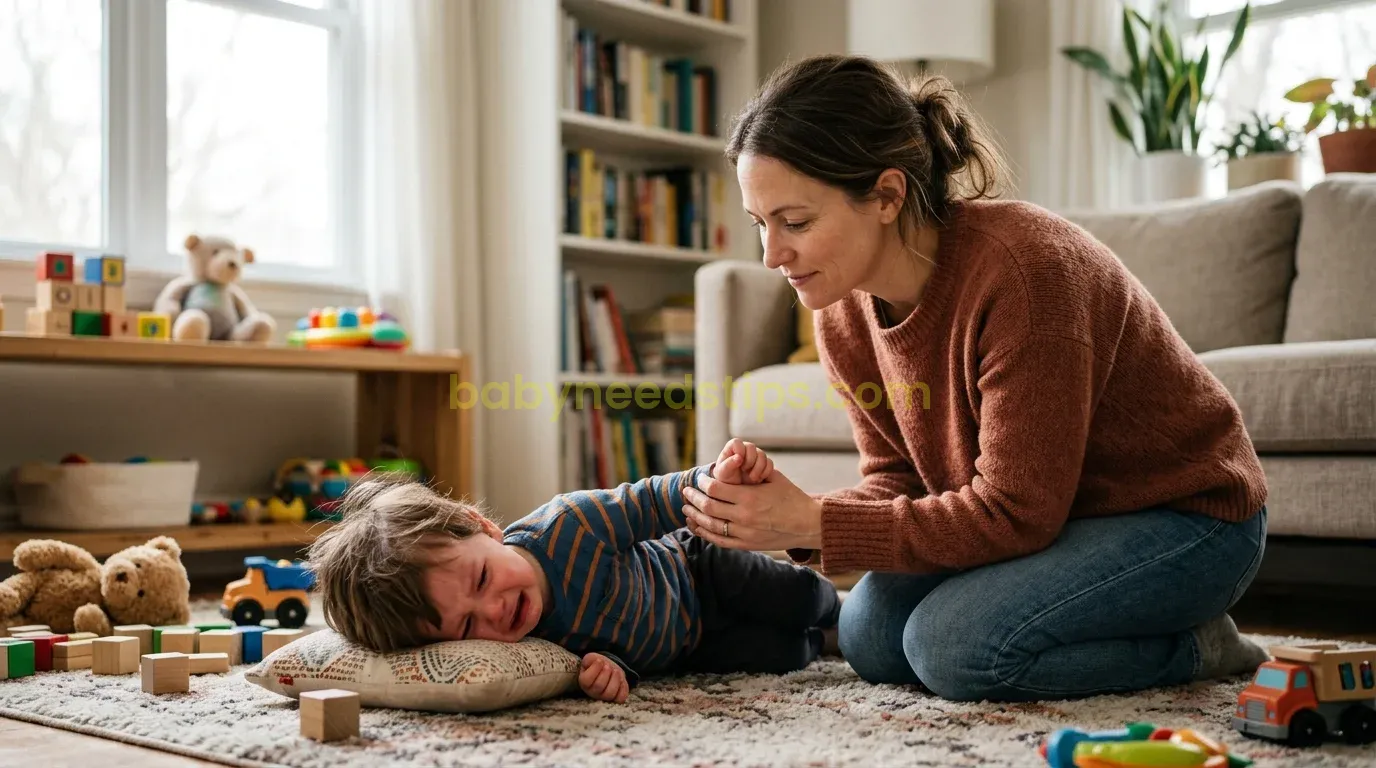
We cannot talk about staying calm without addressing the elephant in the room: parental burnout. As of March 2026, burnout risk is at a record high. The Family Health Index™ by Cleo revealed that burnout among parents of preschoolers jumped from 34% in 2024 to a staggering 49% in 2025. If you feel like you’re “hanging on for dear life,” you are statistically in the majority.
The high-pressure world of “Instagram-perfect” gentle parenting has contributed to this. Upworthy’s February 2025 report noted that parents who “gentle parent” often have higher stress levels than those who use traditional methods, largely because there is no single, clear definition of the style, leading to constant second-guessing. One-third of gentle parents report feeling uncertainty and a sense of “parenting failure” (Gitnux, 2026).
To combat this, the 2026 trend is “Practical Mental Health.” This involves dropping the “performative” aspects of parenting—like themed snack boards or constant “sharenting” on social media—and focusing on “Good Enough” parenting. Nekeshia Hammond, a burnout prevention psychologist, suggests in a February 2025 GBH interview that parents must watch for “red flags” like being unable to enjoy family time or feeling chronic irritability. Sometimes, staying calm for your toddler means admitting you need a five-minute “parental time-out” in the bathroom to reset your own nervous system.
6. The 2026 Reality of Technology and Tantrums
If you think tantrums are getting more frequent, you might be right—and your tablet might be to blame. A landmark study published in JAMA Pediatrics (August 2024) found a “vicious cycle” between screen time and emotional regulation. Toddlers who used tablets frequently showed a decreased ability to manage anger and frustration, which led to more outbursts. Consequently, stressed parents would hand over the tablet to stop the tantrum, further stalling the child’s emotional development.
As we move through 2026, the “Analog Childhood” movement is gaining steam. Nashville Parent (March 2026) reports that “Slow Parenting” is “IN,” while “Overscheduled Kids” and “Extreme Tech” are “OUT.” Families are rediscovering that boredom is a developmental necessity. When a child is bored, they learn to self-entertain and self-regulate.
In my experience, removing the “digital pacifier” leads to a week of intense tantrums (the “extinction burst”), but the long-term results are worth it. Gitnux data shows a 79% improvement in child self-control after one year of consistent, boundary-focused parenting that includes managed digital exposure. If you want a calmer toddler, you may need to look at the “digital load” your family is carrying.
7. Natural Consequences vs. Punitive Discipline
A common question I hear is, “If I don’t punish them, how will they learn?” In 2026, the distinction between consequences and punishment is clearer than ever. Punishment (like spanking or shaming) is intended to cause suffering to “teach a lesson.” Consequences (specifically natural or logical ones) are intended to show the “cause and effect” of behavior.
According to Medium’s 2026 analysis of developmental research, children need to experience consequences to understand how the world works. If a child throws a toy, the natural consequence is that the toy is put away for the day. If they refuse to wear a coat, they get cold. These are not mean-spirited; they are educational. Gitnux reports a 75% success rate in non-punitive boundary setting among families who transitioned away from traditional “drill sergeant” discipline.
The key to staying calm during this process is to remain the “benevolent captain” of the ship. You aren’t angry that you have to take the toy away; you are simply the enforcer of the house rules. “I see you’re sad the toy is gone, but I can’t let you throw things. We can try again tomorrow.” This neutral tone prevents the power struggle that often escalates a 2-minute tantrum into a 2-hour battle.
8. Triggers and Locations: Data-Driven Prevention
Prevention is the best form of intervention. The March 2026 ResearchGate study of 282 parents provides a roadmap of where and why these meltdowns happen. Knowing the “hot spots” can help you stay ahead of the curve.
| Tantrum Metric (2026) | Percentage |
|---|---|
| Daily Frequency | 40.4% |
| Primary Location (Home) | 97.2% |
| Trigger: Unmet Needs/Requests | 95.0% |
| Trigger: Resistance to Transitions | 91.5% |
| Context: Being Left Alone | 83.0% |
In my experience, understanding that 97% of tantrums happen at home should actually feel liberating. It means your child feels safe enough to “fall apart” in their primary environment. However, the 91.5% “transition trigger” gives us a specific tool: the “Pre-Warning.” In 2026, “Cause and Effect” parenting (used by 31% of parents) emphasizes giving kids a roadmap. “In five minutes, we are turning off the TV. In two minutes, we are turning off the TV. Okay, it’s time.” This reduces the “shock” to their system and can prevent the meltdown before it starts.
9. Breaking the Cycle: Healing Your Own Inner child

For many of us, the hardest part of gentle parenting is that we weren’t parented that way. We are “Cycle-Breakers.” According to the September 2025 Kiddie Academy survey, 41% of Gen Z parents are actively working to address negative family patterns. This is heavy work. When your child screams, it may trigger a “fight or flight” response in you based on how your own parents handled your emotions.
Dr. Becky Kennedy’s philosophy—that there are no “bad” kids, only “good” kids having a hard time—applies to you, too. You are a “good” parent having a hard time. The 2026 Modern Parenting Guide suggests that “Repair” is more important than “Perfection.” If you do lose your cool and yell (which 56% of gentle parents still do occasionally, according to Gitnux), the most powerful thing you can do is apologize. “I’m sorry I raised my voice. I was feeling frustrated. Next time, I will take a breath.”
This “Repair” teaches your child that humans make mistakes and that relationships can be mended. It’s a vital skill for their future. The goal isn’t to be a “Stepford Parent” who never gets angry; it’s to be a regulated adult who knows how to come back to center.
10. Expert-Recommended Resources for 2026
If you’re looking to dive deeper into the methods that are actually working this year, several “classic” and “new” resources have emerged as the 2026 essentials. Blinkist (March 2026) and Medium have curated lists of the top-performing guides for modern families:
The Whole-Brain child* by Daniel Siegel & Tina Payne Bryson: Still the “gold standard” for understanding the neuroscience of meltdowns.
Good Inside* by Dr. Becky Kennedy: The primary resource for the “Cycle-Breaking” movement.
Simplicity Parenting* by Kim John Payne: Essential for those looking to reduce the “environmental stress” that leads to tantrums.
Parenting Anxiety* by Meredith Elkins, PhD: A newer 2026 pick for parents struggling with the mental load and “parenting performance” anxiety.
No Bad Kids* by Janet Lansbury: Perfect for those needing a “formula” for acknowledging feelings while setting firm limits.
In my experience, picking one “voice” and sticking with it is better than following twenty different “parenting influencers” on social media. The “expert noise” is a leading cause of the 39% burnout rate reported by Gitnux—so choose a mentor that resonates with your values and ignore the rest.
*
Disclaimer:I am a research journalist, not a medical professional or licensed therapist. The information provided is for educational purposes based on 2024-2026 data trends. If you or your child are experiencing extreme distress, frequent aggression, or signs of clinical burnout, please consult a pediatric specialist or mental health professional. Do your own research to ensure these methods align with your family’s specific needs.
*
Key Takeaways for Staying Calm
- Empathy First: Validate the feeling before correcting the behavior.
- Co-Regulation: Your calm is the most powerful tool in the room. If you aren’t calm, take a 60-second “reset.”
- Firm Boundaries: 2026 data shows kids feel safer with clear, consistent “non-negotiables.”
- Reduce “Digital Load”: High screen time is scientifically linked to increased toddler irritability.
- Prioritize Repair: If you lose your cool, apologize and reconnect. It builds resilience.
- Check for Burnout: Nearly half of preschool parents are at high risk. Self-care is a parenting requirement.
*
FAQ: Gentle Parenting & Tantrums in 2026
Q: Does gentle parenting mean I never punish my child?
A: In 2026, the focus has moved from punishment (inflicting pain/shame) to consequences (natural results of actions). You still set firm limits, but you do so without shaming or physical force. According to Gitnux, this approach reduces defiance by up to 50%.
Q: My toddler hits when they are mad. How is gentle parenting “calm” in that moment?
A: Staying calm doesn’t mean being a doormat. You physically stop the hand (“I won’t let you hit”) and then validate the anger. As Dr. Mary Barbera notes, the goal is to model emotional control so the child eventually internalizes it.
Q: Why does gentle parenting feel so much harder than how I was raised?
A: Because it requires you to regulate two nervous systems—yours and theirs. Traditional “authoritarian” parenting relies on fear, which is “easier” in the short term but leads to worse long-term outcomes. IFS data (2026) suggests the “hard” work of boundaries plus warmth pays off in closer teenage relationships.
Q: Is “Toddler Burnout” real?
A: Yes. Newsweek (November 2025) reported that “Toddler Burnout” is a recognized phenomenon characterized by chronic stress and emotional exhaustion in parents. It is a reflection of the “sustained intensity” of this developmental stage, not a personal failure.
Q: What if my spouse isn’t on board with gentle parenting?
A: 2026 research shows that “versatile” parenting is the norm, with 85% of parents blending styles. The most important factor is consistency in boundaries. If you can agree on the “rules,” the “tone” (gentle vs. traditional) is often secondary to the child’s need for predictability.
Q: Can I use gentle parenting with a child who has ADHD or other neurodivergence?
A: Yes, but it often requires even more structure. Dr. Mary Sheedy Kurcinka’s “Spirited child” approach (popular in 2026) emphasizes working with a child’s specific temperament rather than trying to change it.
*
Conclusion: The Long Game of 2026 Parenting
As we navigate the complexities of 2026, it is clear that the “perfect” parent doesn’t exist. Whether you call it gentle parenting, cycle-breaking, or simply “trying your best,” the data is clear: your relationship with your child is the foundation of their future mental health.
When your toddler meltdowns, they aren’t “failing,” and neither are you. You are both participating in a difficult, necessary developmental dance. By prioritizing your own calm, setting “Boundaries with Empathy,” and focusing on connection over compliance, you aren’t just surviving a tantrum—you are raising a human who will one day know how to navigate their own big feelings with grace.
Take a breath. You’re doing better than you think. According to Gitnux, 73% of parents using these methods report higher life satisfaction. The tantrums will eventually fade, but the bond you’re building in the middle of that grocery store aisle? That lasts a lifetime.